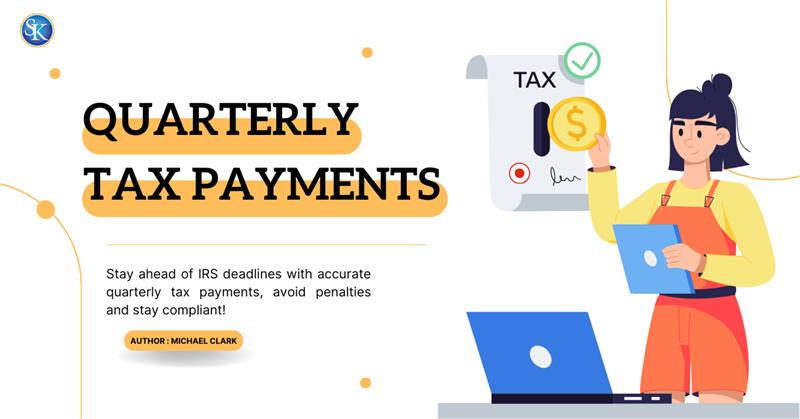
Quarterly tax payments: when should you pay in 2025-2026?
Quarterly tax payments are required if you earn income without tax withholding and expect to owe at least $1,000 in federal taxes for the year. These payments help you avoid IRS penalties and prevent a large tax bill at filing time. If you are self-employed, run a small business, freelance, or earn investment or rental income, quarterly taxes are not optional they are how the IRS expects you to pay taxes throughout the year.
What Are Quarterly Tax Payments?
Quarterly tax payments, also called estimated tax payments, are advance payments made to the IRS four times a year. They cover federal income tax and, for self-employed individuals, self-employment tax (Social Security and Medicare).
The U.S. tax system operates on a pay-as-you-go basis. Employees pay taxes through paycheck withholding, but when no taxes are withheld, the IRS requires estimated payments instead. Paying quarterly keeps you compliant and reduces the risk of penalties and interest.
Who Needs to Pay Quarterly Taxes in 2025–2026?
You generally need to make quarterly tax payments if you fall into one of these categories:
-
Self-employed individuals, freelancers, consultants, and gig workers who receive income without withholding are almost always required to pay quarterly taxes.
-
Small business owners operating as sole proprietors, partners, or S-corporation owners often need estimated payments because business profits are not automatically taxed.
-
Individuals earning rental income, dividends, capital gains, cryptocurrency income, or side-business income may need quarterly payments if withholding does not cover their total tax liability.
-
Even W-2 employees may need quarterly payments if they have multiple income sources or insufficient withholding.
If you expect to owe $1,000 or more after credits and withholding, the IRS generally requires estimated payments.
You can Ask Questions Here about CPA &CFA
Quarterly Tax Payment Due Dates for 2025 and 2026
The IRS uses fixed quarterly periods, though exact dates may shift if they fall on a weekend or federal holiday.
Estimated Tax Deadlines
2025 Tax Year
-
Q1 (Jan–Mar): April 15, 2025
-
Q2 (Apr–May): June 16, 2025
-
Q3 (Jun–Aug): September 15, 2025
-
Q4 (Sep–Dec): January 15, 2026
2026 Tax Year
-
Q1: April 15, 2026
-
Q2: June 15, 2026
-
Q3: September 15, 2026
-
Q4: January 15, 2027
Missing a deadline can trigger IRS underpayment penalties even if you pay your full tax bill later.
How to Calculate Quarterly Tax Payments

To estimate quarterly taxes accurately, start with your expected net income for the year. Net income is your total income minus deductible business expenses.
Next, estimate two components:
-
Federal income tax, based on IRS tax brackets
-
Self-employment tax, which is 15.3% (12.4% Social Security + 2.9% Medicare)
For 2026, Social Security tax applies up to $184,500 of net earnings. Medicare tax continues beyond that limit, with an additional 0.9% surtax for higher earners.
A practical rule many taxpayers use is setting aside 25%–30% of net income for taxes. This is not perfect, but it prevents most underpayment issues and can be adjusted each quarter.
Top accounting and bookkeeping services in Tamap, FL, US
What Taxes Do Self-Employed People Pay in 2025–2026?
Self-employed taxpayers are responsible for both income tax and self-employment tax.
Self-employment tax replaces the payroll taxes that employers normally split with employees. You pay the full amount yourself, but you can deduct half of it when calculating adjusted gross income.
In addition, federal (and often state) income taxes apply based on taxable profit after deductions.
Safe Harbor Rules to Avoid IRS Penalties
The IRS allows taxpayers to avoid underpayment penalties if they meet safe harbor requirements.
You are generally penalty-free if you pay:
-
At least 90% of your current year tax, or
-
100% of last year’s tax (110% for higher-income taxpayers)
This rule is why many business owners base their quarterly payments on last year’s tax bill, then adjust later if income increases or decreases.
What If Your Income Changes During the Year?
Income is rarely steady for freelancers and business owners. If your earnings increase or drop significantly, you can adjust quarterly payments to reflect actual income.
The IRS also allows an annualised income method, which calculates taxes based on when income is earned rather than dividing payments evenly. This is useful for seasonal businesses, real estate professionals, and commission-based earners.
How to Pay Quarterly Taxes
Quarterly taxes can be paid electronically through IRS-approved payment systems, including direct bank payments and online IRS accounts. Payments can also be made by check or approved payment processors.
The key is paying on time, not just paying the correct amount.
Best Practices for Managing Quarterly Taxes
The easiest way to manage quarterly taxes is to treat them as a routine business expense. Track income monthly, save a fixed percentage from each payment you receive, and review numbers one week before each IRS deadline.
Using accounting software or working with a CPA helps prevent missed deductions and penalty-triggering mistakes.
Conclusion
Quarterly tax payments for 2025–2026 are not about paying more tax they are about paying the right amount at the right time. When handled correctly, they prevent penalties, protect cash flow, and make tax season predictable.
FAQs
Do I need to pay quarterly taxes if I’m self-employed part-time?
Yes, if you expect to owe $1,000 or more in federal taxes.
What happens if I miss a quarterly payment?
The IRS may charge underpayment penalties and interest.
Can I pay more often than quarterly?
Yes. You can pay monthly or anytime, as long as enough is paid by each deadline.
Is Form 1040-ES required to file?
Form 1040-ES is used to calculate payments, not filed separately.
Can quarterly taxes be adjusted mid-year?
Yes. Payments can be increased or decreased as income changes.
Do quarterly taxes include state taxes?
No. Some states require separate estimated payments.
How much should freelancers set aside for taxes?
Most set aside 25%–30% of net income to stay safe.
Follow SKFinancial on Facebook / Twitter / Linkedin / Youtube for updates.